June 2023
As a child in the 1960s, I loved the humorous poems about cats in Old Possum’s Book of Practical Cats by a poet called T.S. Eliot.
From these brief lines, you can get a flavour of the delightful images conjured up for children:
“Jellicle Cats wash behind their ears,
Jellicle dry between their toes.”
T. S. Eliot wrote the poems for his godchildren. These poems are the foundation for the musical “Cats” written by Andrew Lloyd Webber – one of the longest running musicals in London’s West End and Broadway.
Little did I know as I enjoyed witty poems about cats at junior school that when I went to senior school, I would discover the darker side of T.S. Eliot’s poetic legacy.
Born in St Louis, Missouri, T.S. Eliot lived in the UK from 1914. He lived in Marlow for a short period during which he discovered that his wife was having an affair with his best friend, also their landlord. He plunged into depressive and misanthropic feelings. His most famous poem “The Waste Land”, published in 1922, is believed to have begun in Marlow.
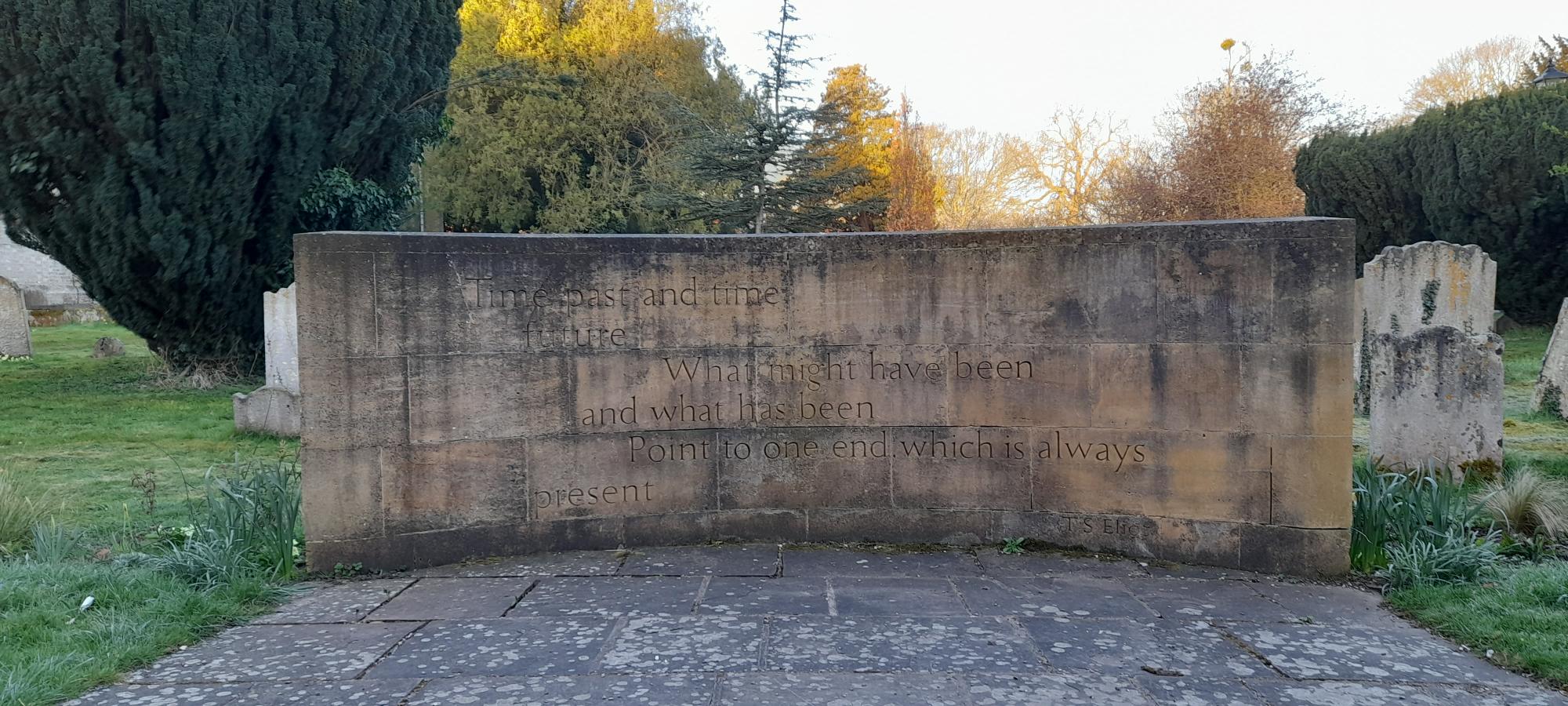
Although his stay in Marlow was brief, it is remembered in Marlow graveyard with a stone memorial, inscribed with the quote:
Time past and time
Future
What might have been
And what has been
Point to one
End which is always
Present.
It is an example of his more profound philosophical poetry, which is very artistic, but it is also very dark and for most of us, inaccessible. It did have a huge impact, and T. S. Eliot was a leading figure in modern English language poetry in the early 20th century. He was awarded the Nobel Prize for Literature in 1948, and he is commemorated at Poets’ Corner in Westminster Abbey.
I would not claim to be inspired by T. S. Eliot’s poetry, it is too obscure for my capabilities. However, “The Waste Land”, with its theme of despair and confusion after war, was useful reading as I tried to immerse myself in the mood of post-civil war Kimalloa.