Do you have the courage to stand up to an absolute ruler, risking imprisonment and losing your livelihood or life? And you would not just be putting yourself in peril—bullies come for your family as well. Not many of us have that type of courage. But we can look around the world, and at history, and be inspired by the brave few taking on tyrants. In England in the 1600s, when philosopher Thomas Hobbes famously observed that life was “nasty, brutish and short”, a modest country gentleman called John Hampden had the courage to stand up to King Charles I. It was said by the philosopher William Godwin in the 18th century that John Hampden was one of the most remarkable men in the annals of history. But modern textbooks barely mention his role in the run-up to the English Civil War. It irks me. Is it because he was a team player, a hard worker, and a modest man that we can’t appreciate his impact today?
Who is this John Hampden, who has a cameo role in Mary Shelley’s Frankenstein, and inspired the Founding Fathers of the United States, the Chartists and the Suffragettes? He was English, but Scotland’s Hampden Park is named after him! The principle on which he fought the king, in the courts and on the battlefield, was what we know today as “no taxation without representation”. We are not aware of the real John Hampden saying those words himself, but it was said under the pseudonym “John Hampden” by the American Revolutionary, James Otis Jr.
John Hampden was a fairly typical Puritan gentleman. He was born into a long line of Hampdens, who had sustained their land-holdings in Buckinghamshire through loyal service to Norman, Plantagenet and Tudor monarchs as administrators or attendants. His character starts to emerge in 1621, when James I was selling peerages. He refused to buy one, eschewing the House of Lords for a seat in the House of Commons. He became a Commissioner for Sewers. Glamourous, huh? But it was a good apprenticeship in negotiating with landowners to clear their ditches, maintain their flood defences and ensure some rudimentary waste disposal was present in towns.
As a young MP, John Hampden developed a strong friendship with the Leader of the House, Sir John Eliot. In the 1620s, they were briefly imprisoned with about seventy other MPs for refusing to pay forced loans. They worked together on the 1628 Bill of Rights which extended Magna Carta and ensured that taxes could not be levied without Parliament’s consent. In 1629, Sir John Eliot was sent to the Tower and kept in harsh conditions. He died there in 1632. It must have been clear to John Hampden what he risked by following his friend’s example.
After King Charles dissolved Parliament in 1629 and began his personal rule, he instituted a tax called Ship Money. Regardless of what it was for, it was imposed without the consent of Parliament and John Hampden began a campaign of non-compliance. He wasn’t the only prominent dissident, but Charles chose to use him as a test case, and he was called to trial in front of twelve judges appointed by the King. If Charles hoped that John Hampden would be derided by the public as a rich tax-dodger, he miscalculated. Although John Hampden lost the case and paid up, five of the judges agreed with his arguments that Ship Money was an illegal tax. People had queued to pack the courtroom and hear the verdict. John Hampden was feted as “Father of the People” and “The Great Patriot”. Readers of “Heroes and Traitors” may assume, quite rightly, that John Hampden is the inspiration for Yoshi Clayhills.
The Ship Money collapsed and Parliament was recalled in 1640. John Hampden could be found in Westminster, working hard in committees. He was revered even by opponents as a wise and calm leader, a man of integrity. One Royalist commented “his reputation for honesty was universal, and his affections seemed so publicly guided that no corrupt or private ends could bias them”. Of course, disputes between the King and Parliament continued. In January 1642, King Charles entered the House of Commons with a troop of soldiers to arrest five members for treason. John Hampden was one of them. The Five Members as they became known, had been tipped off and escaped. Charles commented: “My birds have flown”.
What’s really interesting about this episode, is that back in Buckinghamshire, the locals did not take kindly to the King trying to arrest their local squire. At least one thousand of them, many more according to some reports (at a time when the population of the county was barely more than 60,000), marched to London to call on the King to lay off their man. They were called the Buckinghamshire Petitioners. At a time when only 2% of the population could vote, why did so many people care about their local MP? We can only assume that he was much loved.
The King raised his standard, and the English Civil War began. John Hampden raised an Infantry Regiment, the Buckinghamshire Greencoats, and set out to do his bit in the Civil War as Colonel Hampden. Imagine – you’re a committee man, a politician, and all of a sudden you have to lead men to their deaths. He had no military experience. Yet, he became a popular commander. The Greencoats saw action in several battles and sieges, most notably at the Battle of Brentford, after which, Parliamentary Captain John Stiles wrote a eulogy to John Hampden’s brave role in containing the Royalist forces.
“I have seen him in the front of his regiment in green
When death about him did in ambush lie
And whizzing shot, like showers of arrows, fly
Waving his conquering steel, as if that he
From Mars had got the sole monopoly
Of never-failing courage.”
Sadly, within a few months, on June 18th 1643, John Hampden was defeated and wounded, let down in the face of shrewd tactics from the King’s commander Prince Rupert by reinforcements that never came. He died a few days later. England lost someone very special. There are so many “what ifs?” and “might have beens”. It has been written that the whole nation mourned John Hampden. A neighbouring MP and friend Arthur Goodwin wrote: “He was a gallant man, an honest man, an able man, and take all, I know not to any man living second… I would lay it to heart that God takes away the best amongst us”.
It was John Hampden’s young cousin, Oliver Cromwell, that eventually led Parliament to victory.
Despite his legacy in the radical movements of the 18th and 19th centuries, by the 1950s, few people in Buckinghamshire knew why they were surrounded by Hampden buildings and place names. In 2026, he ran second to a sci-fi novelist in a poll of Bucks legends. Maybe, as a modest man, he would prefer it that way. He did his bit and the world moved on. But that’s precisely why we need him as a role model, especially for young people aspiring to take on political roles. He was someone who had values and worked hard for them, taking great risks on behalf of a greater good, not expecting recognition or reward. An extraordinary man, indeed.
:
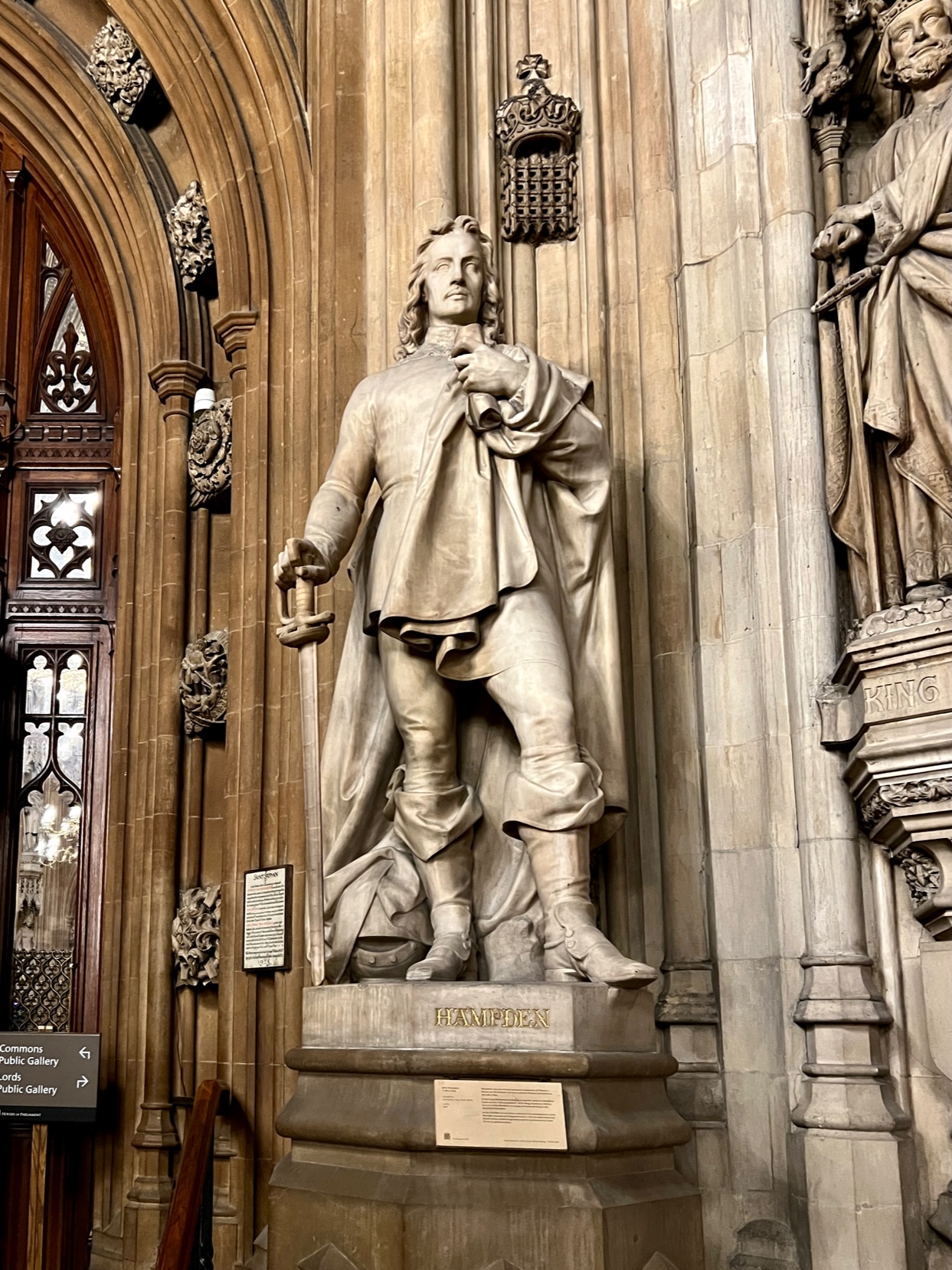
Photo: John Hampden is one of very few MPs to have a statue in the House of Commons.