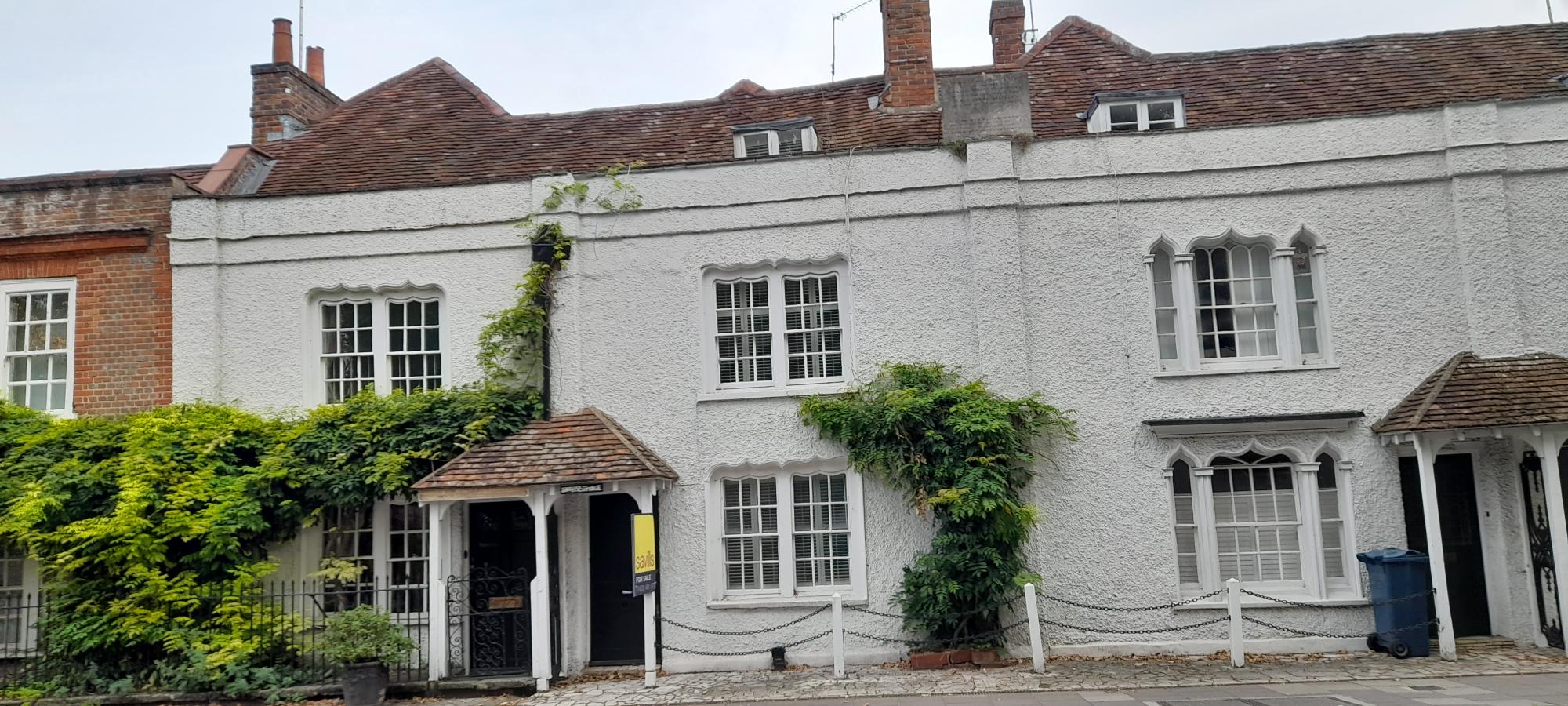
If you look up to the large grey slab on top of this building which was put up there a long time ago, you would learn that the poet Percy Bysshe Shelley once lived here, briefly. He was running away from his debts. You certainly did not want him as a customer. The headline on this slab, and the less obvious blue plaque, should be: “Frankenstein was edited here”. Every writer knows that the greater part of creating a book is editing, re-writing, editing again…. Anyway, let’s start with Mr Shelley’s poetry.
Shelley wrote a poem about revolutionary ideals called “The Revolt of Islam” while he was living here, but he is best known for lyrical poetry. His work was well-loved in the 19th and 20th centuries. For modern tastes, it might be a bit flowery. He was a Romantic with a capital R after all. Nevertheless, I am very envious of what he could do with words. Here is the first verse of his ode to a skylark, which is so popular that the phrase “Hail to thee, blithe Spirit” has more or less entered the language.
“Hail to thee, blithe Spirit!
Bird thou never wert,
That from Heaven, or near it,
Pourest thy full heart
In profuse strains of unpremeditated art.”
He goes on for many verses, finding beautiful metaphors for this tiny brown bird with its fine voice. My favourite is:
“Teach us, Sprite or Bird,
What sweet thoughts are thine:
I have never heard
Praise of love or wine
That panted forth a flood of rapture so divine.”
“That panted forth a flood of rapture so divine” is a real “wow” line for me. Skylarks do sing their hearts out and their song is heavenly, but how many of us would have thought of expressing it like Shelley? I do try writing poetry, but I have to confess that my favourite form is haiku, because it is short and I can focus on crafting just a few words.
Writers long to craft compelling plots as well as beautiful lines, and for this we can envy the other occupant of this cottage at that time. Shelley’s teenage wife Mary edited her epic novel Frankenstein in this cottage in 1817. When it was published in 1818, they were not expecting royalties, but it has had more impact than Shelley’s poetry. I think that it is remarkable that this young woman designed and wrote such a profound allegory.
Although we are supposed to root for Victor, the ambitious scientist who creates a life which he immediately despises – to me, the real protagonist in the book is the monster. He does some terrible things to take revenge on Victor, and that is difficult to read. But, we are challenged to understand what rejection has done to him to make him so destructive. There is a passage in the book that makes me very sad. The monster makes friends with a blind couple. Because they cannot see him, they judge him by what he does. When they are made aware that they have been harboring an ugly thing, the monster is rejected, and he has to run away, again.
Mary Shelley gave us a classic page-turning horror novel which is also a moral tale. Don’t judge by appearances is one of the lessons, but the underlying theme of the book must be – if you are going to play God, think through the “what-ifs?”. Scientists are driven by the pursuit of knowledge in its own right, but it does have moral consequences. Frankenstein is a very serious story. It is surprising that it lent itself to some pretty bizarre but entertaining interpretations by the early film industry.